How Shopify stores describe and size their product photos
On 30 September 2026 we read the product photos of 171 Shopify stores. 42 came from Shopify's own list of the 50 best Shopify stores. The other 129 are small stores whose owners had posted their shop on Shopify's community forum to ask for feedback.
Three results
- About 1 in 6 product photos has text that describes that photo. The best stores and the small stores came out the same, at 17%.
- On 54% of stores in both groups, a product page shows several photos and no two of them are described differently. Every photo carries the same label, usually the product name, or none.
- The one real gap is photo size. 25 of the 129 small stores (19%) uploaded most of their main product photos under 1000 pixels on the shorter side, less than half the 2048 x 2048 that Shopify says "usually displays best". Among Shopify's 42 showcase stores, 1 did.
Why the text on a product photo matters
Alt text is the only part of a product photo that a search engine or a screen reader can read as words. Google's image SEO guide (Google Search Central, last updated 2 March 2026) calls it "the most important attribute when it comes to providing more metadata for an image". Shopify's help center says alt text "describes a media item and is an important part of a product description", and that assistive technology uses it "to describe an image to a customer who's visually impaired".
When a store leaves it blank, the theme often fills the gap with the product name. A shopper with a screen reader who swipes through five photos of a boot can hear the same name five times and never learn that one photo shows the laces and another the sole.
Finding 1: about 1 in 6 photos is described, in the best stores and small stores alike
We read the store-written alt text on 5,042 photos across 820 products, 5 products per store.
| Shopify showcase stores | Small stores | |
|---|---|---|
| Stores audited | 42 | 129 |
| Photos read | 1,329 | 3,713 |
| Photos where the store wrote no text at all | 53% | 46% |
| Photos whose text describes that photo (estimate) | 17% | 17% |
The estimate comes from 250 of the texts that looked like descriptions, up to 3 per store, each read and coded one at a time. About half really did describe the photo, such as a line naming the laces and the boot in that shot, or one pointing out the brand tag on a knitted bootie in a close-up. The rest were the product name with the brand and a string of search terms, the same name with a color added, or a sales slogan that said nothing about the picture.
The best stores were not better at this. Shopify's showcase stores left text off more photos than the small stores did, and the median showcase store wrote nothing on 85% of the photos we read, against 50% for the median small store. That gap did not pass our test for a real difference, so the fair reading is that nobody does this well.
Finding 2: half of product pages tell no two photos apart
The text a store writes is not always what the page serves, because the theme can add its own. For each store we opened one live product page with two or more photos and read the alt text each photo is actually served with.
| Live product page, one per store | Shopify showcase stores | Small stores |
|---|---|---|
| Pages measured | 39 | 117 |
| No two photos described differently | 54% | 54% |
| Every photo described differently | 26% | 27% |
On a third of the showcase pages (13 of 39) and a fifth of the small-store pages (23 of 117), the one label on every photo was the product title, word for word.
Finding 3: small stores upload their main photo small
Here the two groups split. We read the size of the first photo of every product in each store's public product feed, up to 250 products per store: 5,223 products for the showcase group and 14,591 for the small stores.
| Main product photo, shorter side under 1000 px | Shopify showcase stores | Small stores |
|---|---|---|
| Stores where most main photos are that small | 1 of 42 (2%) | 25 of 129 (19%) |
| All main photos, pooled | 4% | 31% |
Shopify's guidance is 2048 x 2048 pixels for a square product image, so a photo under 1000 pixels on its shorter side is less than half of that. Google's image guide says "High-quality photos appeal to users more than blurry, unclear images."
The feed reports each photo's size as uploaded. A theme may serve a resized copy, so this measures what the store has to work with, not what one visitor sees.
What we expected and did not find
Pooled across every product, small stores looked worse on two more counts: 25% of their products had only one photo (8% for the showcase stores), and more of them mixed photo shapes. Counted store by store, both gaps shrank to the size of difference that chance produces with 42 stores. One-photo products were 6% of the median small store catalogue and 5% of the median showcase store. A few large catalogues carried the pooled numbers, so we do not claim either gap.
Before collecting the full sample, we also expected small stores to describe their photos worse than the showcase stores. They did not.
How to fix both
- Write one line per photo about what that photo shows and the others do not: "back view with the heel tab", "worn with jeans", "close-up of the stitching". Shopify recommends 125 characters or less.
- Do not paste the product name and search terms into every photo. Google's guide warns that filling alt attributes with keywords "results in a negative user experience and may cause your site to be seen as spam".
- Read Shopify's suggestions before you accept them. Its media editor "might suggest alt text for images where alt text isn't already filled in", and a suggestion is saved only when you accept it.
- Upload the main photo large. Aim for Shopify's 2048 x 2048 for square photos, and keep one shape across your featured images, which Shopify's help center also recommends.
One shirt, three photos, three lines
On half the pages we measured, all three of these photos would carry the same label. Under each one is the line we would write for it, which is also its alt text on this page.
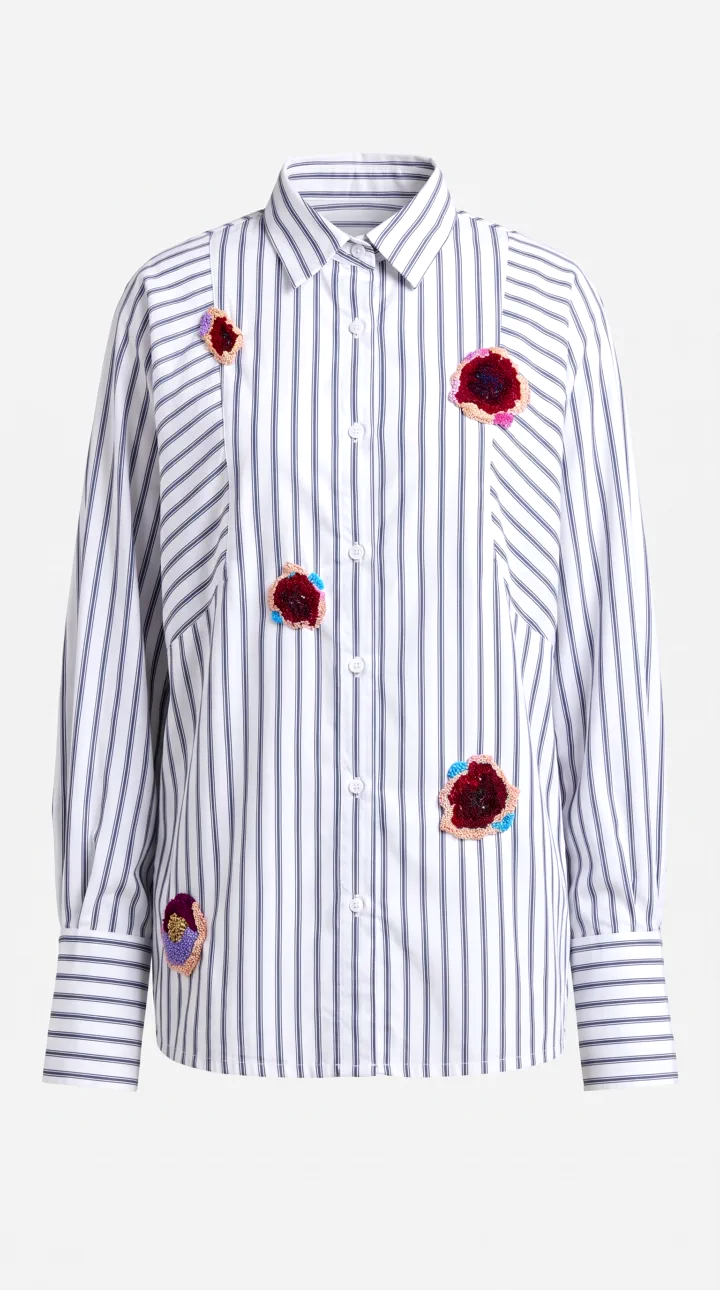
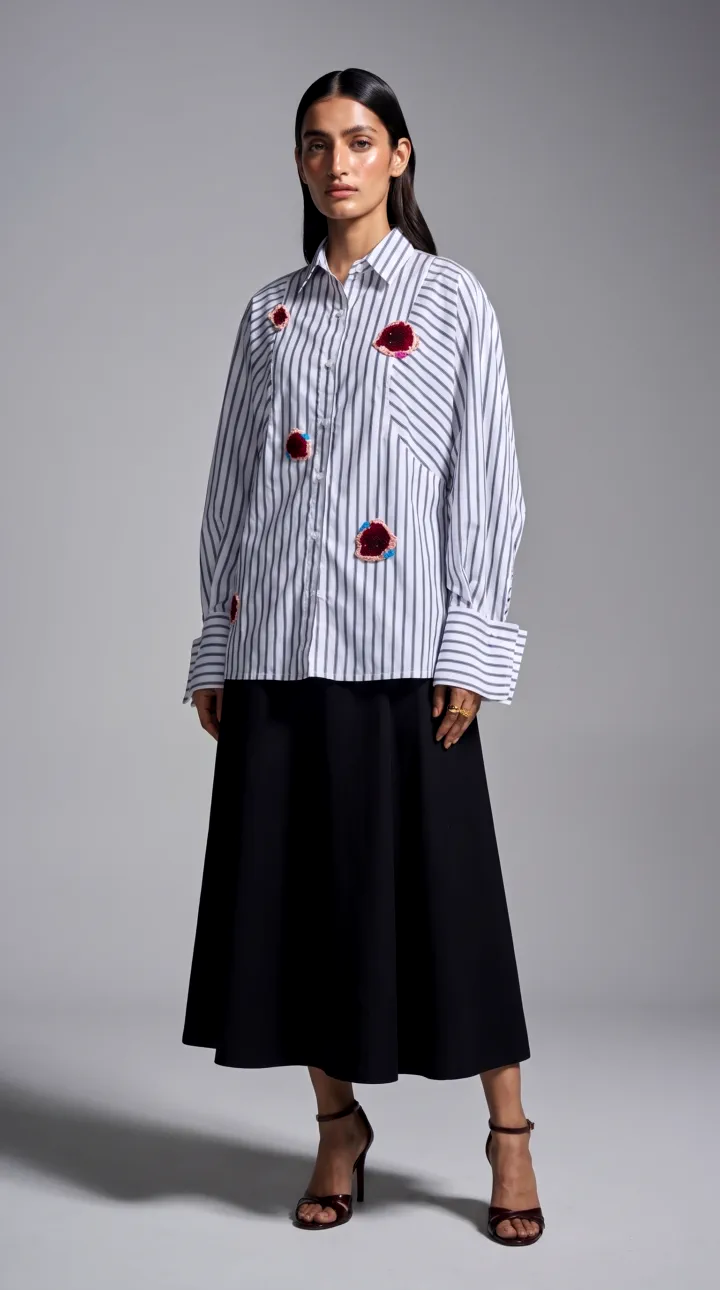
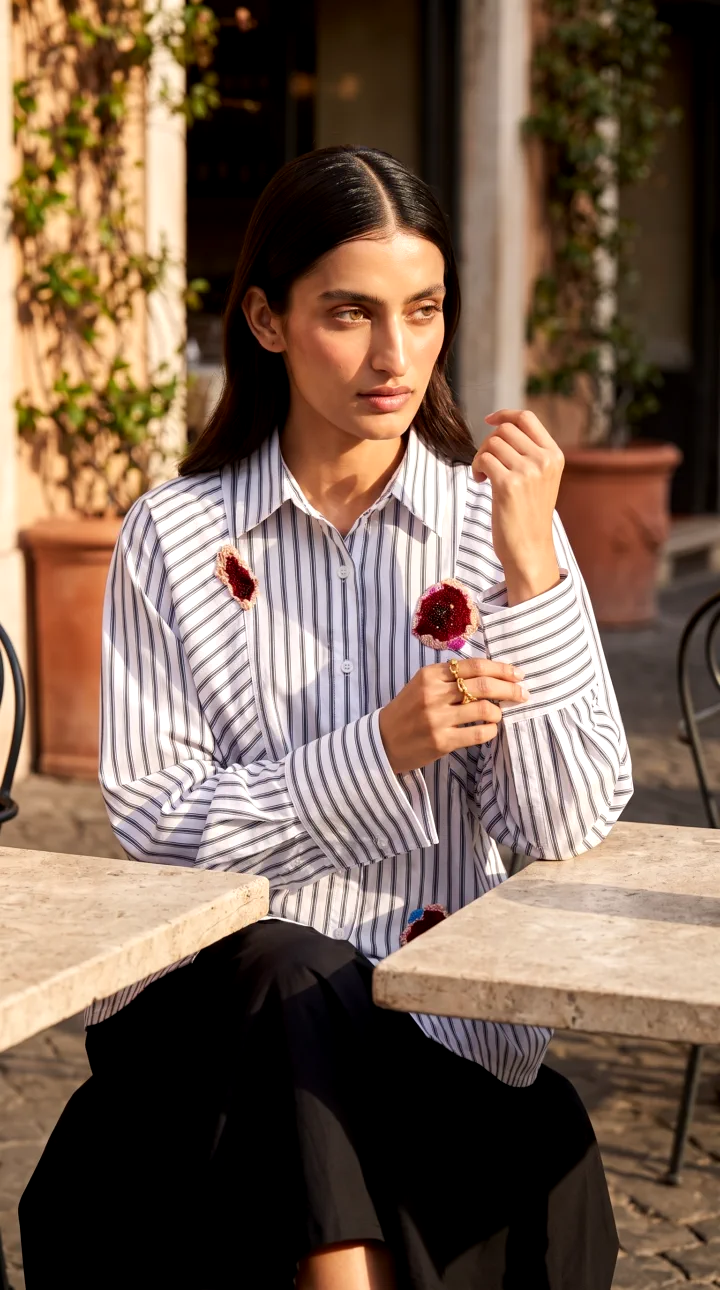
All three made in CherryShot, September 2026, and exported at 1536 x 2752 pixels.
If your main photos are small because all you have is one phone shot per product, CherryShot is built for that: you upload one photo of your product and it builds studio scenes, lifestyle settings and on-model shots around it. Pro mode adds a 4K option when you need photos larger still than the three above.
How we did it
- Showcase group: the stores linked from Shopify's article "50 Best Shopify Stores to Inspire Your Own (2026)", dated 2 December 2025. Of 49 store addresses, 42 had a readable product feed.
- Small-store group: store addresses that owners posted on the "Feedback on my store" board of Shopify's community forum, newest threads first, posted between May 2025 and September 2026. We took only the first post of each thread and its first store link. Of 222 stores tried, 129 were audited. Of the rest, 9 asked robots not to read their product pages and were skipped, 51 could not be reached, and the others were locked, not on Shopify, or returned errors. One store that appeared under two addresses was counted once.
- Per store: the public product feed for photo sizes and counts, the product data of 5 products spread through the catalogue for the store-written alt text, and one live product page for the alt text actually served. We waited 1.5 seconds between requests, used a named user agent, followed robots.txt, and downloaded no photos. No accounts, no carts.
- Coding: each of the 250 saved description-like texts was coded as describes the photo, name plus one detail, name or keywords only, sales line, or other. One coder, with no second check yet. The 17% estimate weights each store's coded share by how many such texts it had.
- Differences: we call a gap between the groups real only when a two-sided Fisher exact test gives p under 0.05, counting stores, not photos. Mostly small main photos passed (p = 0.006). Mostly one-photo products (p = 0.36), mixed shapes (p = 0.16) and leaving most photos without text (p = 0.29) did not.
A note on the method: Shopify's community terms ask account holders not to monitor the service with automated means. We hold no account and logged into nothing. The forum was used only to list store addresses owners posted publicly. Every measured number comes from the stores' own public pages. No store is named here, and none will be.
Limits
- Small stores that ask a forum for feedback are likely newer and smaller than the average Shopify store. Read the second group as stores still finding their feet, not as all Shopify stores.
- 42 showcase stores is a small group. The size gap is large enough to pass the test. Smaller gaps would not have.
- Alt text was read on 5 products per store, not the whole catalogue.
- No store is named here, and none will be.
Study questions, answered
What share of Shopify product photos have alt text?
In our sample, stores wrote their own alt text on about half of product photos (47% for Shopify's showcase stores, 54% for small stores). Only about 1 in 6 photos had text that described that specific photo.
What size should Shopify product photos be?
Shopify's help center says that for square product images, a size of 2048 x 2048 px usually displays best, and it accepts images up to 5000 x 5000 px. In our study, 19% of small stores uploaded most main photos under 1000 px on the shorter side.
Do Shopify themes add alt text automatically?
In our sample, many live product pages fell back to the product name when a photo had no alt text, which is why every photo of a product can end up with the same label. Shopify's media editor can also suggest alt text, which is saved only if you accept it.
Sources: Google Search Central, Image SEO best practices (last updated 2 March 2026). Shopify Help Center, Adding alt text to media and Product media types. Shopify blog, 50 Best Shopify Stores to Inspire Your Own (2026) (2 December 2025, showcase list). Our data: 171 stores, collected 30 September 2026.
Writing alt text for your own store? Our guide: alt text for product images. Running a full shoot? See the AI photoshoot page.